 how-to
7 Steps to Mobile EV Emergency Charging
Last Updated: November 4, 2026
Quick Summary
Mobile EV charging brings a charging truck with an onboard battery bank to your stranded electric vehicle, delivering DC fast charging or Level 2 charging on site. Request it with one call: give your exact location, vehicle make, model and year, state of charge, and whether the car will accept a charge, then confirm the arrival window and price before you agree.
- Pull fully off the travel lane, turn on hazards, and stay behind the barrier while you wait.
- Have your exact location, vehicle details, state of charge, and callback number ready before calling dispatch.
- Choose towing instead if the car shows a high-voltage fault or will not accept a charge.
- Expect a boost sized to reach the nearest working charger, not a full charge in minutes.
- Never step into the travel lane to flag down the charging truck; wait for the driver to reach you.
Table of Contents
- What to Do if Your EV Runs Out of Power
- How to Request Roadside Mobile EV Charging
- How a Mobile EV Charging Truck Works
- Mobile Electric Vehicle Emergency Charging Cost
- Mobile Electric Vehicle Emergency Charging for Tesla
- Emergency Charging Versus Towing: Which to Choose
- Realistic Range Expectations and Roadside Safety
- Request Mobile EV Charging in Central Texas
- Frequently Asked Questions
What to Do if Your EV Runs Out of Power
A depleted battery on an electric vehicle is a roadside emergency, not a mechanical failure, and the right response is to stop safely, stay visible, and call for a mobile charging unit rather than a tow.
Range anxiety is real, but the failure mode is usually simple: a misjudged gap between chargers, climate control draining extra kilowatt-hours, or a planned stop being offline. None of that damages the car; panic does.
Pull Over Safely and Assess Your Situation
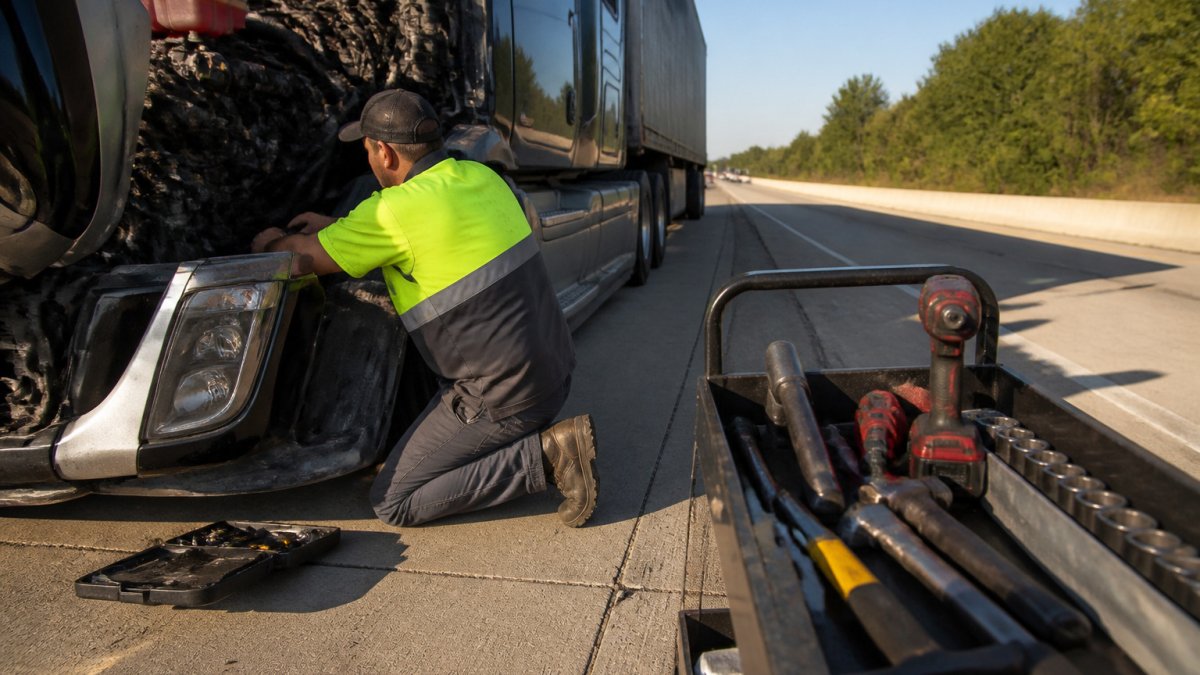
Get as far right as you can, onto the shoulder or an exit ramp, and put the hazard lights on immediately.
Do not open the hood. There is nothing under it a driver can fix on an EV.
Stay inside with seatbelts on if traffic is fast and close.
Then take stock: what percentage does the dashboard show, how far is the nearest charger, and do you have a charging cable?
Gather the Details a Dispatcher Needs
Before you call, have five things ready, the difference between a fast dispatch and a long back-and-forth.
- Exact location: highway, direction of travel, nearest exit or mile marker, and a landmark if you have one
- Vehicle make, model, and year: a Tesla Model 3 and a Ford F-150 Lightning need different connectors
- Current state of charge: the percentage on the dash, even if it reads zero
- What you need: enough charge to reach a station, or a full charge on site
- A callback number and safe standing spot
A common mistake is describing the location as "near the outlet mall" when the dispatcher is routing a truck from twenty minutes away. Give coordinates from your phone's map app if you can; that detail saves the most time.
How to Request Roadside Mobile EV Charging
Requesting mobile EV charging takes one call: you describe the location and vehicle, the dispatcher confirms a unit is available, and you get an arrival window before the truck leaves.
- Call dispatch and state that you have a stranded electric vehicle with a depleted battery
- Read out your exact location and confirm direction of travel
- Give the make, model, and year so the right connector and charging power are loaded
- Confirm your state of charge and whether the car will accept a charge at all
- Ask for the arrival estimate and the price before you agree
- Stay with the vehicle, keep hazards on, and answer the driver's call when they are close
If your vehicle will not accept a charge because of a fault, not just an empty battery, say so. For a fuller walkthrough of how fast on-site help gets dispatched, see how to get 24/7 mobile truck repair fast.
How a Mobile EV Charging Truck Works
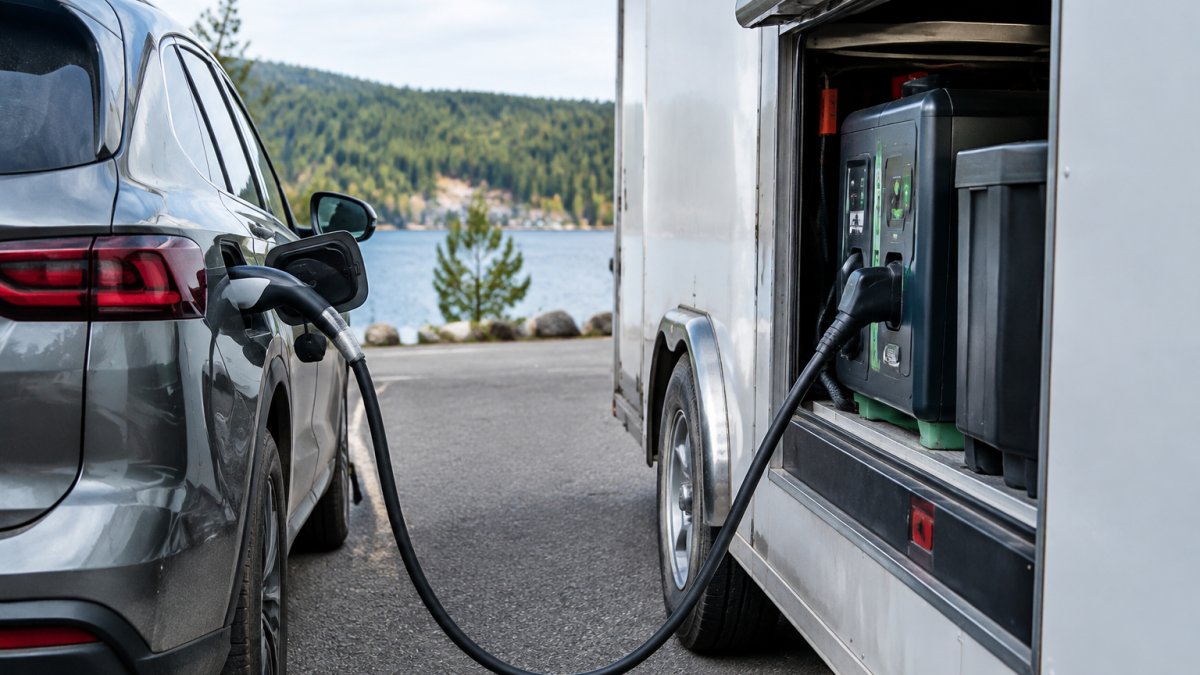
A mobile EV charging truck is a service vehicle carrying a large onboard battery bank, an inverter, and a set of charging connectors, which delivers DC fast charging or Level 2 charging directly to a stranded car. The truck becomes a portable charging station that comes to you.
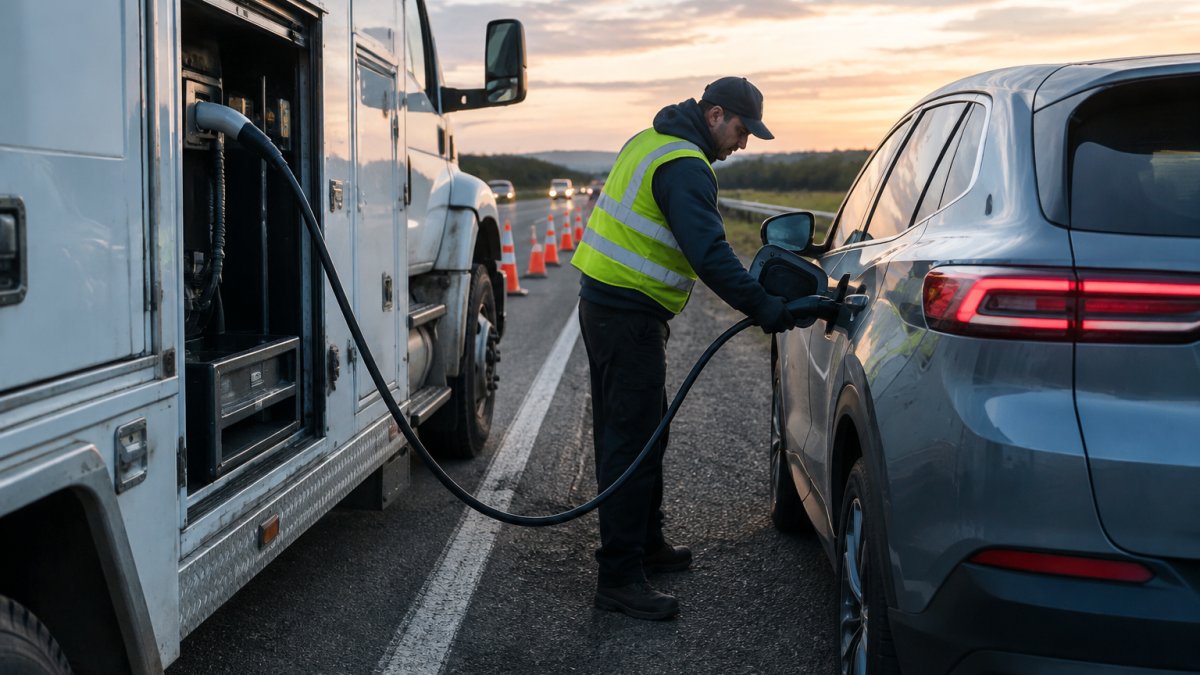
Charging power depends on the equipment used and your car's onboard limits.
For a deeper look at how mobile mechanics operate on site, read our guide to mobile mechanics for commercial trucks.
Mobile Electric Vehicle Emergency Charging Cost
Ask for the total cost in one figure before you agree, and check the quote against the price listed on Ryan's Mobile Repair LLC's website or obtained through a direct quote.
Pricing depends on distance, time of day, and energy needed. A call a few miles from a depot and one forty miles out carry different fuel, labor, and drive-time costs, and a weekday afternoon boost is not a midnight holiday call.
What Drives the Final Price
- Distance and drive time: the distance to your location can affect the quote.
- Time of day: the timing of the call can affect the quote.
- Energy delivered: ask how the energy portion of the quote is calculated.
- Vehicle and connector: the vehicle model and connector type may affect the quote.
- Outcome: ask how the quote applies if the vehicle cannot accept a charge.
Mobile Charging Versus Towing Versus Public Charging
Compare the price with the alternatives on the same call. Towing and public charging each carry their own costs and limitations, and the total depends on your situation.
Mobile charging can avoid the cost of a tow when the car is healthy and the only problem is a low battery. Towing wins when the car has a fault, since paying for a charge the car cannot accept is money wasted.
Questions to Ask Before You Agree
Ask these on the phone, not at the roadside:
- Is the quote flat-rate or metered by the kilowatt-hour delivered?
- Is there an after-hours, weekend, or holiday surcharge?
- Is mileage billed beyond a set radius, and what is that radius?
- Is there a fee if the vehicle cannot accept a charge?
- Does the price include getting the car to a charger if charging fails?
- What payment methods are accepted on site?
Compare the full quoted total rather than headline rates.
For a realistic breakdown of what mobile service costs compared with shop alternatives, see our mobile versus shop repair cost comparison.
Mobile Electric Vehicle Emergency Charging for Tesla
Tesla owners have a specific advantage and a specific risk: the Supercharger network, and the assumption that one is close when the nearest is beyond your remaining range.
Mobile electric vehicle emergency charging for Tesla works the same way as for any other EV, with one detail that matters: the connector.
A few Tesla-specific points worth knowing:
-
The car may show zero range and still creep a short distance to a safer spot
-
Tesla's own roadside assistance exists, but coverage and wait times vary by region and plan
-
Preconditioning the battery in cold weather draws power, so plan charging stops with a margin
Do not rely on the navigation estimate alone when the battery is low; it assumes ideal conditions. Wind, elevation, and heater use all cut into real range.
Emergency Charging Versus Towing: Which to Choose
Mobile charging may suit a vehicle that is otherwise healthy and only needs a charge. Choose towing when the car will not accept a charge, shows a high-voltage fault, or is in a location too dangerous to wait in.
Work through the questions below in order. The first one that gives a clear answer usually settles the choice.
Step 1: Is the Stop Location Safe to Wait In?
If the car is in a live travel lane, on a blind curve, or in a construction zone with no shoulder, safety outranks speed. Move to a safer spot if the car can still creep, call for police-assisted traffic control if needed, and treat towing or a protected move as the default.
If you are fully off the travel lane behind a barrier, waiting for a charging truck is reasonable.
Step 2: Will the Car Accept a Charge?
A depleted battery is not the same as a fault. If the dash shows zero but the car powers on, shifts, and shows no high-voltage warning, a charge will likely take.
Watch out: paying for a charging session on a car that cannot accept a charge is the most common wasted call. Tell the dispatcher about any warning lights before the truck rolls.
Step 3: How Far Is the Nearest Working Charger?
If a working charger is within a short, safe creep or a few minutes of range, the cheapest path is often to reach it under your own power or with a small boost. If the nearest charger is beyond your remaining range, or you do not know whether it is online, mobile charging brings the power to you and removes the guesswork.
Step 4: What Does Each Option Cost and How Long Does It Take?
Towing usually means a hook fee, a per-mile rate, and then a shop visit or charging stop on top. When the car is healthy, mobile charging may be faster than towing; when it has a fault, the tow is the only option that fixes the problem.
Quick Decision Table
| Situation | Better Option | Why |
|---|---|---|
| Battery empty, car otherwise fine, safe shoulder | Mobile charging | Faster and gets you moving without a shop visit |
| Car will not accept a charge or shows a high-voltage fault | Towing | A fault needs diagnosis, not power |
| Stopped in a live traffic lane or blind curve | Towing or police-assisted move | Safety outranks speed |
| Close to a working charger | Slow creep or short charge | Cheapest path back on the road |
| Remote location, no charger nearby | Mobile charging | Truck brings the power to you |
| Unsure whether the charger ahead is online | Mobile charging | Removes the risk of a second stranding |
Towing is not wrong, it is just slower and usually costs more once you add the shop visit. Charging is the lighter-touch fix when the only problem is a depleted battery. For a side-by-side of emergency roadside options, our article on emergency roadside repair for trucks covers how the choices compare.
Realistic Range Expectations and Roadside Safety
No mobile unit turns an empty battery into a full one in minutes.
Dashboard range estimates are optimistic.
The charging session happens on the shoulder, often with traffic passing at speed. Stay behind the barrier, keep the hazards on, and let the technician work.
Watch out: drivers who step out to flag down the charging truck from the lane create the single most dangerous moment of the whole call.
Request Mobile EV Charging in Central Texas
Ryan's Mobile Repair LLC provides mobile automotive and fleet repair across Central Texas, available 24/7, with upfront estimates. If your electric vehicle is stranded with a depleted battery, call, give us the details from the checklist above, and we will tell you the arrival window and the price before you commit.
Ryan's Mobile Repair LLC offers mobile service that comes to you, 24/7 availability, upfront estimates, payment plans, and fleet maintenance.
Contact Ryan's Mobile Repair LLC to request service and get a quote.
Frequently Asked Questions
Is there a portable EV charger for emergencies?
Yes, but portable units are not a full substitute for a mobile charging truck. A portable Level 2 charger can add a small amount of range from a compatible outlet, while a mobile charging unit carries a larger battery and delivers a faster charging boost on site. For a depleted battery on a roadside, call a mobile EV charging service, which brings the charging power and the connector your vehicle needs.
How much does emergency mobile EV charging cost?
Mobile electric vehicle emergency charging cost depends on your location, the time of day, the charging power delivered and whether after-hours service applies. Ask for the full quote before dispatch, including mileage and any after-hours premium, and ask about payment options.
Can a mobile EV charging service charge a Tesla?
Yes. Confirm your model and connector type when you request assistance so the right equipment can be sent. Confirm your model and connector type when you request assistance so the nearest unit arrives with the right cable.
Should you call for a mobile charge or have your EV towed?
Choose mobile charging when the vehicle is otherwise healthy and the battery is simply depleted, especially at home, at work or in a safe roadside spot. Towing makes more sense if the car shows a fault warning, will not shift into gear or is in a dangerous location. Consider the vehicle's condition and location when deciding between mobile charging and towing.