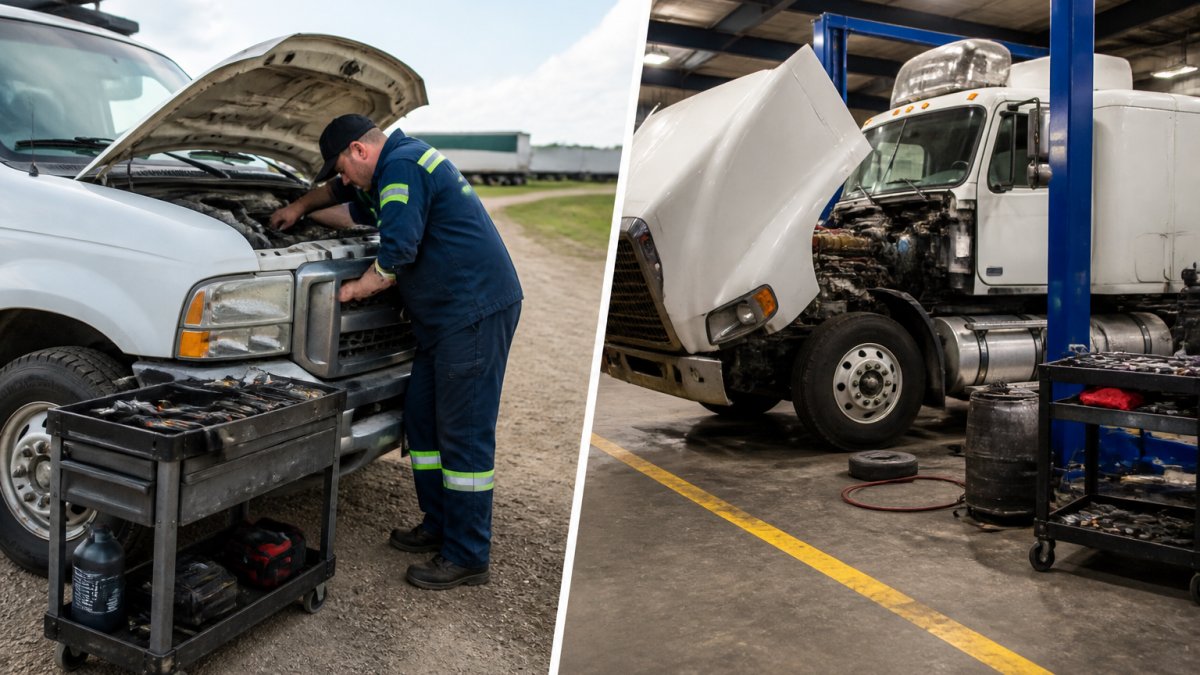
 comparison
Mobile vs Shop Repair Cost: What You'll Really Pay
Last Updated: October 23, 2026
Quick Summary
The cost of mobile vs shop repair depends on more than the hourly rate: mobile service usually charges a higher labor rate plus a service call fee, while shops have lower rates but add travel, towing, and lost time. Compare complete itemized estimates, not rates alone.
- Mobile mechanic labor rates generally run higher per hour than shop rates, plus a service call fee.
- A service call fee covers the trip to your location, not the repair itself.
- Shops win on rate, mobile wins on time; neither is cheaper in every case.
- Use a mobile mechanic when the vehicle runs and the job is accessible from outside.
- Repairs needing a lift, press, alignment rack, or controlled environment belong in a shop bay.
Table of Contents
- Mobile vs Shop Repair Cost: The Full Picture
- How Mobile Mechanic Labor Rates Compare to Shop Hourly Rates
- What a Mobile Mechanic Service Call Fee Actually Covers
- Shop Overhead vs Mobile Operating Costs: Where the Price Gap Comes From
- Reading a Mobile Mechanic Repair Estimate Line by Line
- When to Use a Mobile Mechanic and When a Shop Still Wins
- Warranty, Liability, and Verifying a Quote Before You Commit
- Conclusion
- Frequently Asked Questions
Mobile vs Shop Repair Cost: The Full Picture
The cost of mobile vs shop repair comes down to one truth: the invoice rarely tells the whole story. At Ryan's Mobile Repair LLC, we provide upfront estimates to ensure a transparent and stress-free experience.
Mobile service usually carries a higher labor rate and a service call fee. Shops spread rent, equipment, and staff across every job, so their hourly rate often lands lower.
Below, we break down where each dollar goes, how to read a mobile vs shop repair estimate line by line, and which jobs belong in a bay rather than your driveway.
How Mobile Mechanic Labor Rates Compare to Shop Hourly Rates
Mobile mechanic labor rates generally run higher per hour than shop rates, and that is not a markup for convenience. It is the price of sending a fully equipped technician to one vehicle instead of working on four at once.
A shop bills one technician's hour across a lift full of cars; a mobile tech bills that hour to a single customer, plus the drive.
The premium is not uniform. For a broader look at how mobile pricing is structured, see our guide on how much a mobile mechanic costs.
What a Mobile Mechanic Service Call Fee Actually Covers
A mobile mechanic service call fee covers the trip to your location, not the repair itself.
Drivers often read this fee as a hidden charge. It is not. It pays for fuel, drive time, and the fact that the technician cannot take another job while traveling to you.
Three things to confirm before you book:
- Whether the fee is flat or distance-based. A flat fee is easier to budget; a distance fee can climb fast on a rural call.
- Whether it is waived if the repair proceeds. Some providers credit the fee toward the work.
- Whether a diagnostic charge is separate. Many mobile mechanics combine diagnosis and service call into one visit fee.
Ask for the fee in writing before the technician rolls. A reputable provider gives an upfront estimate, which is how we handle every call at Ryan's Mobile Repair LLC.
Shop Overhead vs Mobile Operating Costs: Where the Price Gap Comes From
Shop overhead is the largest reason shop rates stay lower, and it is easier to understand as fixed versus variable costs. A brick-and-mortar garage carries fixed monthly obligations, rent, insurance, lift and alignment-rack payments, diagnostic software, waste disposal, and front-desk staff.
Mobile operating costs work the opposite way. There is no storefront rent, but there is a service vehicle, fuel, vehicle maintenance, portable tools, and dead time between calls.
Here is how the two cost structures compare line by line:
Cost Category | Shop | Mobile |
|---|---|---|
Storefront rent | High, fixed monthly | None |
Service vehicle and fuel | Not applicable | Ongoing per-job cost |
Equipment | Full lifts and heavy tools | Portable, duplicated sets |
Staffing | Shared across many jobs | One tech per job |
Travel time | Customer travels to shop | Technician travels to customer |
Downtime cost to customer | Often a full day | Minimal |
Diagnostic software | Shared subscription | Duplicated subscription |
Waste disposal | Contracted, fixed | Handled at a shop or disposal site |
The takeaway: shops win on rate, mobile wins on time. Neither is cheaper in every case.
How the overhead gap shows up in a real estimate
The overhead difference is easiest to see when you compare complete, out-the-door estimates for the same job rather than hourly rates alone. Take a brake pad and rotor replacement on a mid-size sedan. A shop quote might show a lower labor rate, but the total includes travel to the shop, a possible diagnostic charge, and a lost day. A mobile quote might show a higher labor rate plus a service call fee, but the total excludes the tow, the second trip, and the lost workday.
A practical way to compare is to build a total-cost worksheet for each option:
- Labor: quoted hours multiplied by the labor rate, with drive time listed separately if the provider bills it.
- Parts: OEM, aftermarket, or remanufactured, including any core charge.
- Diagnostic fee: whether it is separate and whether it is credited toward the repair.
- Service call or travel fee: flat, distance-based, or credited toward the work.
- Towing: the cost of getting a non-running vehicle to a shop, or zero if the mobile tech comes to it.
- Supplies and disposal: shop supplies, brake cleaner, and disposal fees, which are legitimate but should be itemized.
- Your time: the value of a lost workday or a second trip, which is the cost most quotes leave out.
Why the gap is not uniform across repairs
Simple jobs with short drive times can land close to shop pricing because the mobile provider's variable cost per job is small. Complex jobs needing a lift, a second set of hands, or extensive teardown often price far apart, because the provider must bring specialized equipment or decline the job.
Regional and vehicle-specific factors also move the comparison. Labor rates vary by market, parts availability varies by make and model, and urgency, a vehicle that will not start versus one that can be driven, changes whether a tow enters the estimate at all.
Reading a Mobile Mechanic Repair Estimate Line by Line
A mobile mechanic repair estimate should list parts, labor hours, the labor rate, the service call fee, and any diagnostic charge as separate lines. If a quote arrives as one lump sum, ask for the breakdown before you approve anything.
Here is how we would read a quote, and what to check on each line:
- Parts. Confirm whether they are OEM, aftermarket, or remanufactured. Ask if the price includes a core charge.
- Labor hours. Compare the quoted hours to the job, not to the clock. A brake job and an engine repair should not quote the same time.
- Labor rate. Confirm it is hourly and ask whether drive time is billed separately.
- Service call fee. Check if it is flat, distance-based, or credited toward the repair.
- Diagnostic fee. Ask whether it is waived if you approve the repair.
- Taxes and disposal fees. These are legitimate; just make sure they are itemized.
When to Use a Mobile Mechanic and When a Shop Still Wins
Use a mobile mechanic when the vehicle runs, the job is accessible from outside the car, and your time is worth more than the rate premium.
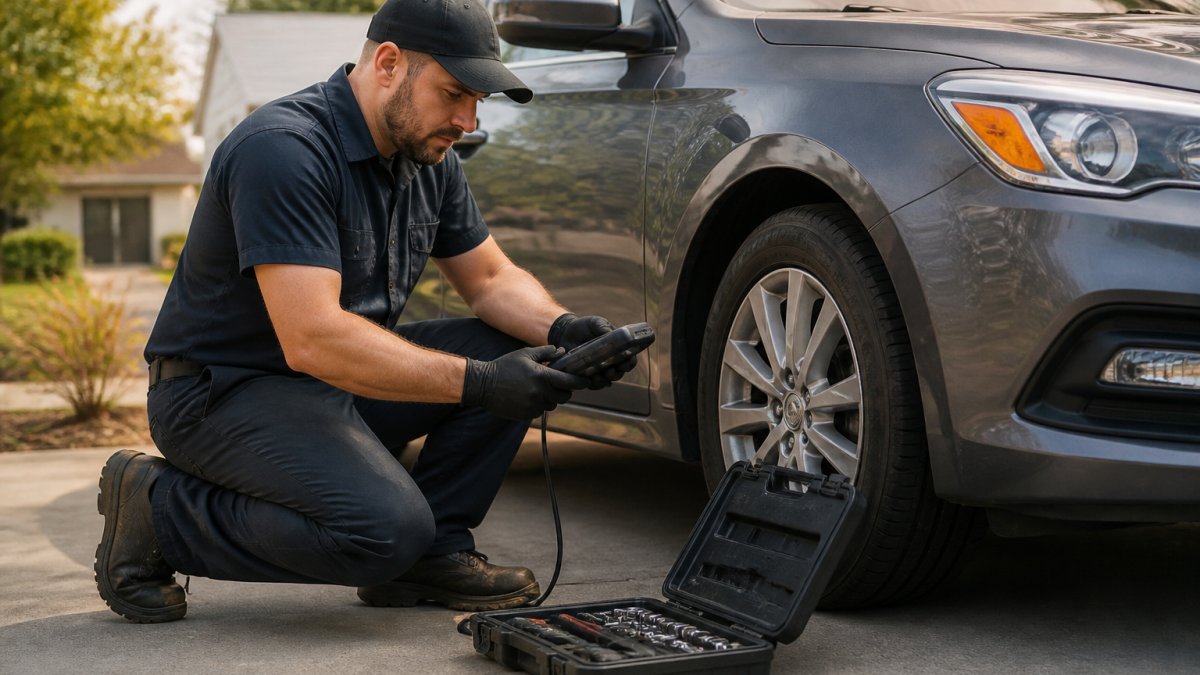
A shop still wins when the repair needs a lift, a press, an alignment rack, or a controlled environment.
There is also a safety limit. If a vehicle cannot be moved safely, or the failure involves a brake or steering component that makes driving hazardous, a tow to a shop is the honest answer.
For fleet managers, the split is usually scheduled maintenance on site and heavy repairs at a shop. That single rule removes most of the guesswork and keeps vehicles on the road longer.
Warranty, Liability, and Verifying a Quote Before You Commit
Warranty and liability terms separate a professional mobile provider from a driveway side job, and they are the decision factors most cost comparisons leave out.
On warranty, confirm whether coverage applies to parts, labor, or both, and whether it is honored if you move or break down elsewhere.
Recourse matters as much as coverage. If a repair fails, ask: who do I call, how quickly will they return, and will they cover a tow or a second visit?
How to verify a quote and a mechanic
Verifying a quote takes ten minutes and saves real money. Use this checklist before you commit:
- Confirm the provider's business name and ask for the estimate in writing
- Ask for the technician's certifications and whether they are current
- Confirm the labor rate, service call fee, and diagnostic fee in writing
- Ask what happens if the job turns out bigger than expected
- Confirm warranty terms on parts and labor, including duration and claim process
- Check that the provider carries liability insurance and can show proof
- Confirm whether the diagnostic fee is credited toward the repair
- Ask whether the quoted parts are OEM, aftermarket, or remanufactured
- Confirm who pays for a tow or second visit if the repair fails
That last point matters more than most drivers realize. A provider without insurance leaves you exposed if a lift fails or a tool damages your vehicle, and one without a written warranty leaves you no recourse if a part fails early. At Ryan's Mobile Repair LLC, we provide upfront estimates and stand behind our work, and we would rather answer these questions before the job than after it.
For fleet managers, keep a copy of each provider's certificate of insurance and written warranty terms on file. That single habit removes most of the risk from using mobile service across a fleet.
Conclusion
The real cost of mobile vs shop repair is not the hourly rate. It is the rate plus your time, your downtime, and the risk of an unverified quote. Mobile service costs more per hour and gives you back a day; a shop costs less per hour and asks you to come to it.
If your vehicle runs and the job is accessible, mobile repair is often the better trade. If it needs a lift or a controlled bay, a shop is the right call, and we will tell you so.
Frequently Asked Questions
Are mobile mechanics cheaper than repair shops?
It depends on the job, not the category. A mobile mechanic often charges a similar or slightly higher hourly rate than a shop but adds a service call or travel fee. The savings come from avoiding a tow, taking time off work, and paying for a second diagnostic visit. For a brake job or battery replacement at your home or office, the total out-the-door cost is frequently lower. For a timing belt or transmission rebuild, a shop's fixed facility and specialized equipment usually make it the cheaper and safer choice. Get a written estimate from both before deciding.
Do mobile mechanics charge a service call or travel fee?
Most do, and it is usually disclosed upfront. The mobile mechanic service call fee covers driving to your location, fuel, and setup time, and it may be flat or scaled by distance. Some providers waive it when you approve a larger repair. Ask three things before booking: whether the fee is separate from labor, whether it applies per visit or per vehicle, and whether it is credited toward the repair if you go ahead. A transparent provider will put all of that in the estimate.
What repairs can a mobile mechanic handle on-site?
Mobile mechanics typically handle brakes, batteries, starters, alternators, belts, hoses, fluid changes, tune-ups, suspension components, and most diagnostic work. They carry hand tools, jacks, and scan tools, and many fleet-focused providers can service multiple commercial vehicles at one location. Jobs that need a lift, alignment rack, welding, or an enclosed bay for engine and transmission work generally belong in a shop. If the mechanic arrives and finds the job is bigger than quoted, a good provider stops, explains the safety limit, and helps arrange a tow rather than forcing the repair.
Should I get estimates from both a mobile mechanic and a repair shop?
Yes, for any repair above a routine oil change. Ask each side for a line-item mobile mechanic repair estimate that separates parts, labor hours, the service call fee, and any diagnostic charge. Then compare the total out-the-door number, not the hourly rate alone, and factor in the cost of a tow or a lost workday if you use a shop. Two written quotes take about 20 minutes to collect and usually reveal which option is genuinely cheaper for that specific job.