 how-to
How to Get 24/7 Mobile Truck Repair Fast
Last Updated: October 25, 2026
Quick Summary
A 24/7 mobile truck repair service brings a mechanic and a stocked service truck to your breakdown location, day or night, instead of requiring a tow to a shop. It covers roadside diagnostics, brake and tire work, batteries, belts and hoses, fluid and air leaks, and on-site mechanical repairs. Confirm a live dispatcher has actually assigned a technician before you settle in to wait.
- A live dispatcher should collect your exact location, vehicle type, symptom, load status, and a working callback number.
- Ask for the technician's name and a dispatch reference number before you hang up.
- A technician should tell you within 15 to 30 minutes whether the repair is roadside-capable or a tow is safer.
- Tires, batteries, belts, hoses, fuel filters, air lines, and minor brake work are common roadside fixes.
- Engine teardown, transmission work, and structural damage generally require a shop with a lift.
Table of Contents
- What 24/7 Mobile Truck Repair Actually Includes
- Emergency Mobile Truck Repair: What to Do While You Wait
- How Dispatch, Diagnosis, and Onsite Repair Work
- When a 24 Hour Truck Mechanic Can Fix It at the Roadside
- Mobile Semi Truck Repair: What a Roadside Tech Can and Cannot Handle
- What a Commercial Truck Breakdown Service Should Cover
- How to Verify a Provider Before You Call
- Call Ryan's Mobile Repair for 24/7 Service in Central Texas
- Frequently Asked Questions
What 24/7 Mobile Truck Repair Actually Includes
A 24/7 mobile truck repair service brings a mechanic and a stocked service truck to your breakdown location, day or night, instead of requiring a tow to a shop. At Ryan's Mobile Repair LLC, we run this model across Central Texas, and the scope includes roadside diagnostics, brake and tire work, battery and electrical service, belts and hoses, fluid and air leaks, and on-site mechanical repairs.
The "24/7" part matters most. A commercial truck breakdown at 2 AM does not wait for business hours, and every hour off the road costs a fleet money.
Here is what a genuine 24/7 mobile truck repair call typically covers:
- Roadside diagnosis using scan tools and visual inspection
- Brake, tire, and battery service for common failures
- Belt, hose, and fluid leak repairs that stop a truck cold
- Diesel engine and general mechanical work within roadside limits
- Trailer repair, including lights, air lines, and liftgate issues
What separates a real service from a phone number that rings out is dispatch. You want a live person who can confirm a truck is coming, not a voicemail box.
Emergency Mobile Truck Repair: What to Do While You Wait
Safety comes before the repair. The Federal Motor Carrier Safety Administration publishes roadside emergency guidance for commercial drivers, and the core advice is consistent: get off the travel lane, mark the vehicle, and stay visible.

Do these things in order:
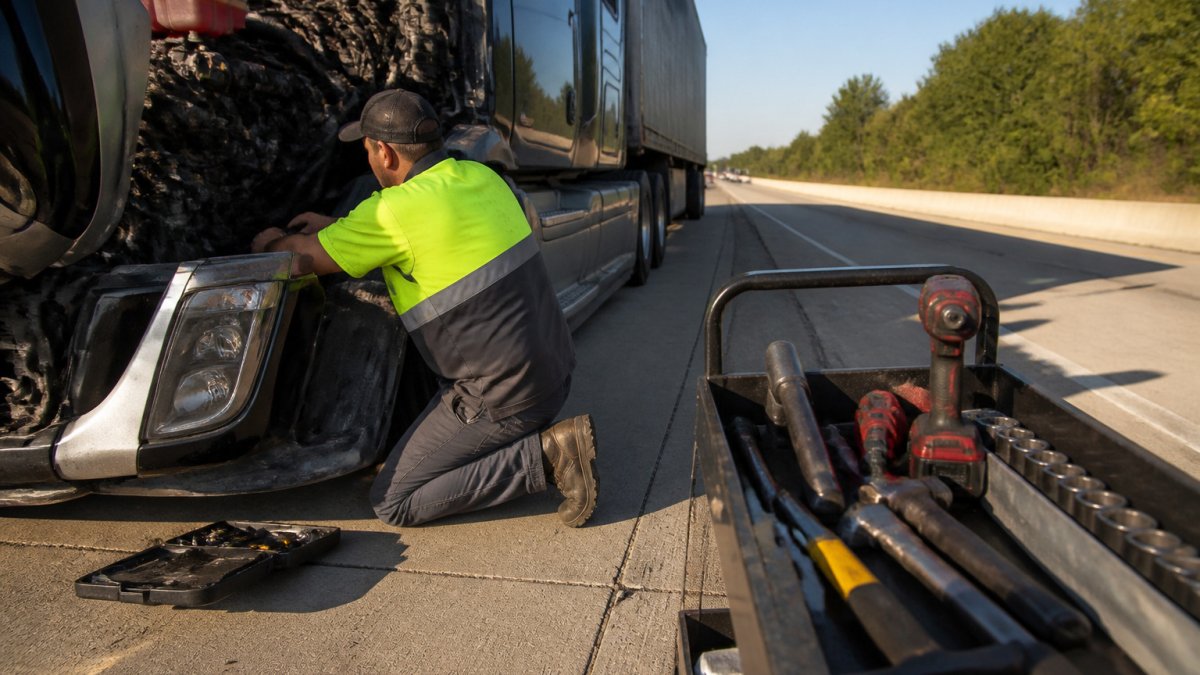
- Pull as far onto the shoulder as possible and turn on hazard lights.
- Set out reflective warning triangles behind the truck, further back at higher speeds.
- Keep passengers and crew away from traffic, behind a barrier if one exists.
- Note your location precisely, including mile marker or exit, for dispatch.
- Stay with the vehicle unless it is unsafe, and keep your phone charged.
A common mistake is standing near the driver-side door while waiting. That puts you in the path of passing traffic. Wait on the safe side, away from the road.
How Dispatch, Diagnosis, and Onsite Repair Work
Most 24/7 truck repair listings stop at "call us." The useful part is what happens after you call. Here is the sequence a competent provider should walk you through, and what you should expect at each stage.
**1.
2. Dispatch confirmation. A real 24/7 operation tells you a technician is assigned and gives a realistic arrival window based on distance, traffic, and current call volume. Ask for the technician's name and the dispatch reference number.
3. Arrival and safety check. On arrival, the technician should park safely, set out warning devices, and confirm the scene is secure before opening the hood or crawling under the truck. This is also when you should confirm the estimate before any work begins.
4. Roadside diagnosis. A mobile technician typically works with a scan tool, a multimeter, a pressure gauge, and visual inspection. What can be diagnosed roadside: fault codes, battery and charging faults, air leaks, coolant and oil leaks, belt and hose condition, brake adjustment, tire damage, and electrical shorts in accessible circuits.
5. The fix-or-tow decision. This is the step most guides skip. A skilled mobile mechanic for commercial trucks should tell you within the first 15-30 minutes whether the repair is within roadside scope or whether a tow is the safer, cheaper path. Common roadside-capable fixes include tires, batteries, belts, hoses, fuel filters, air lines, and minor brake work.
6. Onsite repair and documentation. When the fix is in scope, the technician performs it, tests the repair, and documents what was done, what parts were used, and what should be inspected next. Ask for that documentation before the technician leaves, it matters for warranty claims and for your maintenance records.
A clear dispatch-to-repair sequence is the difference between a two-hour fix and an all-night wait. If any step feels vague, ask direct questions, good providers expect them.
When a 24 Hour Truck Mechanic Can Fix It at the Roadside
A 24 hour truck mechanic can handle most failures that stop a truck without major disassembly. The list is longer than drivers assume:
- Flat tires and tire service
- Battery and electrical failures
- Brake adjustments and minor brake service
- Belts, hoses, and coolant leaks
- Fuel delivery and fuel filter replacement
- Air leaks in lines and fittings
- A/C and heating repair for driver comfort
- Minor welding and light suspension work
The pattern is simple: if the repair needs a lift, a major teardown, or parts the truck does not carry, it belongs in a shop. Everything else is fair game for onsite repair.
Mobile Semi Truck Repair: What a Roadside Tech Can and Cannot Handle
Mobile semi truck repair covers the failures that strand a rig most often, but it has real limits. A roadside technician can restore a semi-truck to safe operation for common issues. Major engine work, transmission overhauls, and structural repairs generally require a shop with a lift and heavy equipment.
Here is the honest split:
| Repair Type | Roadside Capable | Needs a Shop |
|---|---|---|
| Tire and battery service | Yes | No |
| Brakes, belts, hoses | Yes, minor work | Major overhaul |
| Fuel filter and fuel delivery | Yes | No |
| Air and fluid leaks | Yes, most cases | Internal failures |
| Diesel engine teardown | No | Yes |
| Transmission work | No | Yes |
Knowing this split before you call saves wasted time. A good provider will tell you which column your breakdown falls into.
What a Commercial Truck Breakdown Service Should Cover
A commercial truck breakdown service should cover response, diagnosis, repair, and clear communication from first call to final invoice. For fleet managers, it also needs to fit scheduled maintenance, not just emergencies. Integrating these operational standards ensures that your commercial truck repair strategy remains consistent with the evolving requirements of modern logistics.
The FMCSA commercial vehicle safety resources emphasize keeping equipment roadworthy between inspections, and mobile service supports that by catching small failures before they strand a truck.
What to expect from a solid provider:
- 24-hour availability, including holidays
- A live dispatcher, not a callback queue
- Upfront estimates before work begins
- Warranty or guarantee terms stated clearly
- Fleet maintenance scheduling across multiple vehicles
Ryan's Mobile Repair LLC offers all of this, including payment plans and upfront estimates so you know the terms before a wrench turns.
How to Verify a Provider Before You Call
A five-minute verification call prevents a bad night. Use this checklist and ask for specifics, not reassurances.
Credentials and certification. Ask whether the technicians are certified for the work you need, diesel engine diagnostics, brake service, or electrical repair. Certification alone does not guarantee quality, but a provider that cannot name its credentials is a risk.
Insurance and liability. Confirm the provider carries commercial liability insurance and ask who is responsible if something is damaged onsite. A legitimate operation answers this without hesitation. If the answer is vague, walk away.
Upfront estimate format. Ask how the estimate is delivered, verbal, text, or written, and whether it separates call-out fee, labor rate, parts, after-hours premium, and travel charge.
Warranty terms. Ask what the warranty covers (parts, labor, or both), how long it lasts, and how a claim is filed. A common pattern is a limited warranty on parts and labor for a set period; the specifics vary, so get them stated clearly.
Response-time honesty. Ask how fast the provider can realistically reach your location at this hour, and what factors could change that window (distance, weather, parts availability). A provider that promises a fixed time without asking your location is guessing.
Payment methods and terms. Confirm what payment methods are accepted onsite, whether a deposit is required, and whether fleet accounts or payment plans are available. For fleet managers, ask whether the provider can invoice against a purchase order.
Dispatch verification. Ask whether the number you called reaches a live dispatcher or a call center that books subcontractors. Confirm a truck is actually dispatched before you settle in to wait, and get the technician's name and a dispatch reference number.
A provider that dodges any of these questions is a risk. Get the estimate in writing, confirm the warranty, note the dispatcher's name, and keep the documentation with your vehicle records.
Call Ryan's Mobile Repair for 24/7 Service in Central Texas
Breakdowns do not schedule themselves, and the difference between a two-hour fix and an all-night wait comes down to who answers the phone. Ryan's Mobile Repair LLC brings certified mechanics and equipped service trucks directly to you, any hour, across Central Texas.
We handle emergency mobile truck repair, scheduled fleet maintenance, and everything between, with upfront estimates and payment plans available. When your truck is down, call us and get a real answer about when help arrives.
Frequently Asked Questions
What does 24/7 mobile truck repair include?
It covers on-site diagnosis and repair of the problems that stop a truck from running: flat tires, dead batteries, brake issues, air and fluid leaks, belts and hoses, fuel delivery, and minor to moderate mechanical work. A mobile truck repair provider brings tools and common parts to your location, so the truck is fixed in place instead of towed. Major engine or transmission overhauls usually still require a shop, and a good provider will tell you that upfront rather than after you have paid a dispatch fee.
Can a mobile truck mechanic repair a semi on the roadside?
Yes, for many common failures. A 24 hour truck mechanic can replace tires, batteries, brake chambers, air lines, belts, hoses, and fuel filters at the roadside. Mobile semi truck repair also handles electrical faults, liftgate and hydraulic issues, and some welding. The limit is usually the repair itself, not the location: anything needing a lift, a crane, or a controlled clean environment gets referred to a shop. Ask what the technician carries on the truck before you commit.
What should I do while waiting for emergency truck repair?
Get the truck as far onto the shoulder as possible, turn on hazard lights, and set reflective triangles behind the vehicle. Keep the driver inside the cab with a seatbelt on if traffic is close, or behind a barrier if one is available. Note the mile marker, exit number, and nearest cross street so dispatch can find you. Do not attempt repairs yourself on a live highway. Stay reachable by phone so the technician can confirm the location and give an arrival window.
When should I call for a tow instead of mobile truck repair?
Call a tow when the truck cannot be made safe where it sits, when the failure involves structural damage or a rolled or jackknifed trailer, or when the repair needs a lift or major teardown. A commercial truck breakdown service should tell you honestly which category you are in. If a technician arrives and finds the job is beyond roadside scope, you should not be charged for work that was never possible on site. Ask about that policy when you call.
A stranded truck is a costly truck, and the right provider turns a crisis into a short delay. Ryan's Mobile Repair LLC offers 24/7 mobile service, upfront estimates, and fleet maintenance for businesses of every size. Get started with Ryan's Mobile Repair LLC and get your truck back on the road fast.