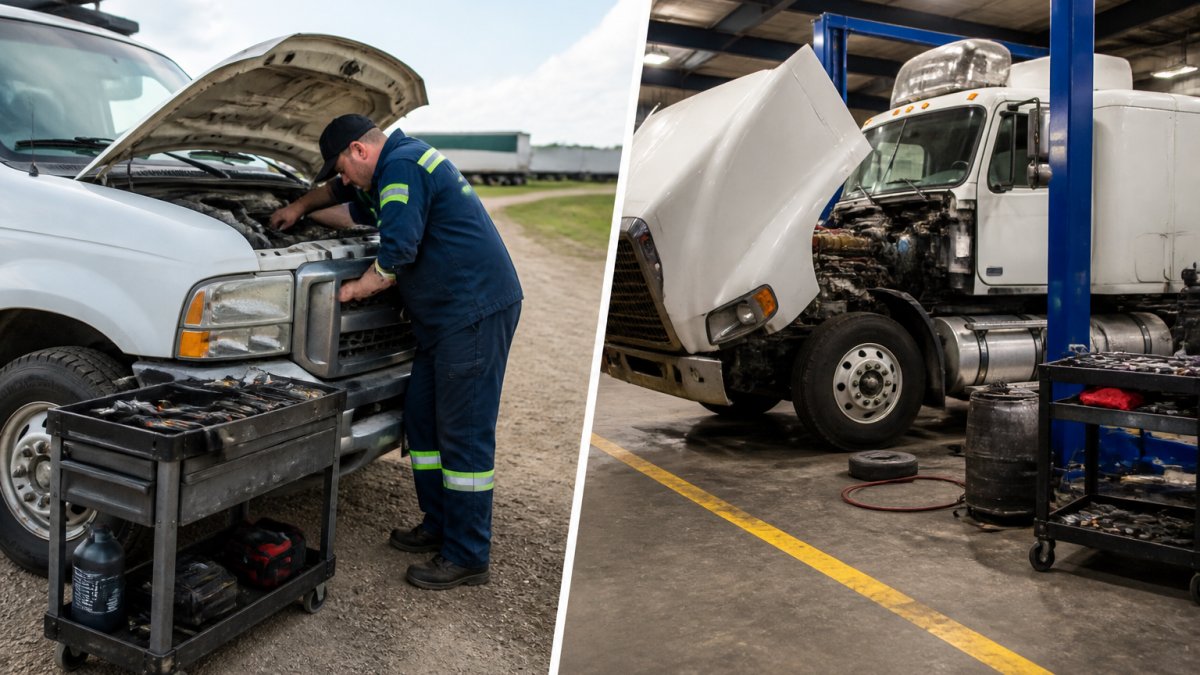
 comparison
7 Truck Fleet Repair Services Texas Fleets Rely On
Last Updated: October 29, 2026
Quick Summary
Truck fleet repair services in Texas bring certified mechanics and diagnostic equipment directly to your yard, terminal, or roadside location instead of requiring you to send vehicles to a shop. Mobile service removes the transport leg entirely, so the technician comes to the vehicle and the truck returns to service from where it already sits.
- Mobile repair invoices typically itemize labor, parts, travel and mobilization, diagnostic time, and emergency premiums.
- A shop visit includes travel, queue time, the repair, and the return trip; mobile service compresses that to the repair itself.
- Under 49 CFR 396.11 drivers must complete a daily post-trip inspection report.
- Under 49 CFR 396.17 a periodic inspection is required at least once every 12 months.
- Ask for a written estimate that separates labor, parts, travel, and any diagnostic fee before dispatch.
Table of Contents
- Why Texas Fleets Are Moving to Mobile Truck Fleet Repair
- Mobile Truck Repair Cost: What Fleet Managers Actually Pay For
- Mobile Truck Repair vs Shop Repair: Downtime, Liability, and Real Trade-offs
- The Truck Fleet Preventive Maintenance Checklist That Cuts Breakdowns
- How Mobile Truck Fleet Repair Services Handle Major Engine and Brake Work On-Site
- Compliance and Technician Certification: What to Verify Before Booking
- Requesting an Upfront Estimate for Your Fleet
- Frequently Asked Questions
Why Texas Fleets Are Moving to Mobile Truck Fleet Repair
Truck fleet repair services in Texas bring certified mechanics and diagnostic equipment directly to your yard, terminal, or roadside location instead of requiring you to send vehicles to a shop. For fleet managers running tight delivery windows, that shift changes the math on downtime. For concrete steps to cut downtime, see how to reduce fleet downtime. This guide breaks down what to consider about these services, how they compare to shop visits, and what to verify before you book.
The core problem is simple. Every hour a commercial truck sits idle, it stops earning. A shop visit usually means a driver waiting, a vehicle out of rotation, and a second trip to collect it. Mobile service removes the transport leg entirely: the technician comes to the vehicle, works on-site, and the truck returns to service from where it already sits.
Logistics operations with vehicles spread across multiple yards cannot afford to shuttle each one to a fixed shop. Mobile service keeps the fleet in place and the schedule intact.
Mobile Truck Repair Cost: What Fleet Managers Actually Pay For
Pricing depends on the job, the parts, and the travel involved, so a flat number is usually not quoted before the vehicle is seen. Understanding the cost structure helps, because it differs from a shop bill in specific ways.
Here is what drives the invoice:
- Labor time, billed by the hour at rates that reflect a certified technician's skill
- Parts, priced at market rates with the same markup structure shops use
- Travel and mobilization, the cost of bringing a fully equipped truck to your location
- Diagnostic time, especially for electrical and aftertreatment faults that take real equipment to trace
- Emergency premiums, which apply when a call comes in outside normal hours or requires immediate dispatch
A common mistake is comparing a mobile quote to a shop quote line by line and missing the costs the shop quote leaves out. Towing, driver downtime, and lost loads rarely appear on a repair invoice, but they are real money leaving your operation. When you factor those in, the gap between mobile and shop narrows fast.
Ask for an itemized estimate that names every line before work begins.
Mobile repair invoices are built from a handful of cost lines that fleet managers should expect to see itemized.
| Cost component | What it covers |
|---|---|
| Labor time | Billed hourly at certified technician rates |
| Parts | Priced at market rates with shop-style markup |
| Travel and mobilization | Bringing a fully equipped truck to your location |
| Diagnostic time | Tracing electrical and aftertreatment faults with real equipment |
| Emergency premiums | Calls outside normal hours or immediate dispatch |
Mobile Truck Repair vs Shop Repair: Downtime, Liability, and Real Trade-offs
The mobile versus shop decision comes down to three things: how long the vehicle is out, who carries risk while it is being worked on, and whether the job fits on-site conditions. Mobile service can reduce downtime. A shop may be better suited to the most complex overhauls, where a lift and a controlled bay matter.
Downtime is the clearest differentiator. A shop visit typically includes travel to the facility, queue time, the repair itself, and the return trip. Mobile service compresses that to the repair itself. For a fleet with a dozen vehicles, that difference compounds across every service interval.
Liability is where fleet managers ask the sharpest questions, and they should. Ask any provider, mobile or fixed, what happens if something goes wrong during the repair. Get the warranty terms in writing, confirm the business carries insurance, and understand who is responsible for the vehicle while it is on your property. A provider that answers those questions clearly before the job is a provider worth keeping.
Some work genuinely belongs in a shop. Frame straightening, certain machine work, and jobs that need a dedicated paint booth are not on-site candidates. Everything else, from brake service to diagnostics to engine work, increasingly is. For a deeper cost breakdown, see our comparison of mobile vs shop repair cost.
The Truck Fleet Preventive Maintenance Checklist That Cuts Breakdowns
A truck fleet preventive maintenance checklist is a scheduled set of inspections and services tied to mileage or engine hours, designed to catch wear before it becomes a breakdown. The checklist itself is not complicated. Following it consistently, and tying it to the federal inspection standard your drivers already sign off on, is what separates a fleet that runs from a fleet that lives on emergency dispatch.
The unique angle most service pages skip: your PM program and your DOT compliance program should be the same program. Under 49 CFR 396.3, motor carriers are required to systematically inspect, repair, and maintain vehicles, and under 49 CFR 396.11 drivers must complete a daily post-trip inspection report. A well-built PM schedule absorbs both requirements instead of running as a separate paper exercise.
Use this as a starting framework and adjust intervals to your manufacturer specs and duty cycle:
- Engine oil and filter change at the manufacturer's interval (track by engine hours on PTO-heavy or idling-heavy duty cycles, not just odometer)
- Fluid checks and flushes: coolant, transmission, differential, power steering
- Brake inspection: pads, drums, air lines, slack adjusters, and pushrod stroke measurement against the adjustment limit
- Tire pressure, tread depth, and rotation, including a tread-depth log so you can spot uneven wear patterns early
- Wheel seal inspection for leaks
- Battery and charging system test
- Belt and hose inspection
- Air filter and fuel filter replacement
- DOT-required lighting and reflector check, documented per 49 CFR 393.9 and 393.11
- Suspension and chassis inspection
- AC system performance check before summer
- Annual periodic inspection per 49 CFR 396.19, with the inspector's qualification on file
The gap between fleets that run reliably and fleets that live on emergency calls is rarely the checklist itself. It is whether anyone actually owns the schedule. Assign a single person to track intervals, and put the dates on a calendar the whole team can see. Most practitioners find that a simple shared calendar with mileage or hour triggers, reviewed weekly, catches more failures than a sophisticated software platform nobody opens.
A practical pattern that works for small and mid-size fleets: group vehicles into service batches by route type rather than by unit number. Line-haul tractors on steady highway miles can stretch oil intervals; delivery trucks on stop-and-go duty cycles cannot. Batching by duty cycle means the technician services similar vehicles in one yard visit, which cuts mobilization cost per unit.
For a deeper walkthrough of how to build that schedule around your actual routes, see our full guide to preventative maintenance for commercial vehicles.
How Mobile Truck Fleet Repair Services Handle Major Engine and Brake Work On-Site
These are safety-critical systems, so the technician should document measurements and show you the results.
Engine work splits into two categories. Engine work is handled case by case. Ask upfront which category your job falls into before the technician arrives.

Diagnostic testing is a large part of most fleet repair work.
Compliance and Technician Certification: What to Verify Before Booking
Certification is the question every fleet manager should ask first, and the answer should be specific. The federal air brake inspection standard under 49 CFR 396.25 sets qualification requirements for anyone inspecting or repairing brakes on commercial vehicles. Ask any provider for documented certifications, not just a verbal assurance.
The compliance angle most service pages ignore: when you hire a repair provider, their work becomes part of your carrier record.
Verify these before you book:
- Relevant certifications for the work being performed
- Insurance coverage, including general liability
- Written warranty terms on parts and labor
- Compliance records that meet federal standards
- References from other fleets of similar size and vehicle mix
The Federal Motor Carrier Safety Administration's maintenance requirements set the baseline for what a compliant repair must meet. Two specific requirements worth knowing: 49 CFR 396.11 requires a driver vehicle inspection report (DVIR) at the end of each day's work, and 49 CFR 396.17 requires a periodic inspection at least once every 12 months. A provider who can speak to those requirements fluently, and who structures their invoices to feed those records, is a provider who understands fleet work rather than passenger cars.
A practical verification step: ask any provider to walk you through how they document a brake job, including before-and-after measurements and the technician's qualifications. If reliability is your concern before switching, our guide on whether mobile fleet repair is reliable covers what to check in detail.
Requesting an Upfront Estimate for Your Fleet
An upfront estimate should tell you what the job includes, what it excludes, and what could change the number. Ask for it in writing before any technician dispatches. The estimate should separate labor, parts, travel, and any diagnostic fee so you can see exactly where the money goes.
Here is how we would structure the request:
- List every vehicle, its make, model, and current mileage or engine hours
- Describe the symptoms or the scheduled service needed
- State your locations and how many vehicles sit at each
- Ask for a written estimate with the cost components broken out
- Confirm response time expectations for emergency calls
- Ask how the provider coordinates with your existing fleet maintenance tracking
That last point matters more than it used to. Many fleets run maintenance scheduling through fleet management platforms. Share your service intervals with any provider so the schedule fits what you already track.
For a quote, contact Ryan's Mobile Repair LLC directly for current pricing.
Fleet downtime is a choice you can manage, not a cost you have to absorb. Ryan's Mobile Repair LLC provides mobile automotive, tractor trailer, and fleet repair services, available 24/7, with upfront estimates and payment plans available. Get started with Ryan's Mobile Repair LLC and put a maintenance schedule in place that keeps your trucks earning instead of waiting.
Frequently Asked Questions
How much does a mobile truck mechanic cost?
Mobile truck repair cost depends on the job, parts, and travel distance, so most providers quote per service rather than publish flat rates. Ask for an upfront written estimate before work begins, and confirm whether payment plans are available for larger repairs.
Is mobile truck repair cheaper than taking a truck to a shop?
It depends on the repair. Compare the full cost, including downtime and towing, not just the invoice.
What types of fleet repairs can a mobile mechanic handle?
Ask the provider upfront which jobs they complete on-site and which they refer out.
How can businesses reduce truck fleet repair costs?
The biggest savings come from preventive maintenance: following a service interval schedule, catching small issues at inspections, and keeping fluid and brake service current. A written truck fleet preventive maintenance checklist, reviewed monthly, prevents the emergency breakdowns that drive the highest repair bills.